Sunday, March 6, 2016

Destination Outer Space

Basic Rocket Science and Rocket Components
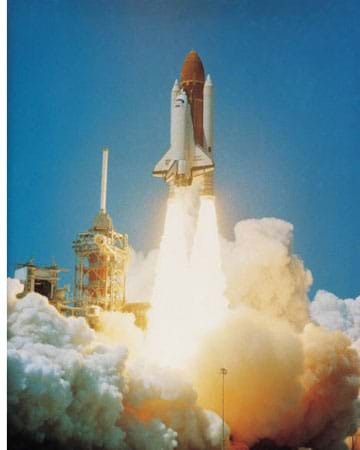
Rockets are essentially a massive sustained explosion in which the hot gases from the combustion process are directed to create thrust. Of course, it is a very carefully controlled and directed explosion — no small engineering feat! Engineers must design fuel tanks and nozzles that are just the right size, shape and thickness to withstand the pressure of the explosion and accelerate the fuel away. Engineers also design materials and components that can handle the heat and vibrations generated. If their design is too heavy, the rocket may be strong but will not fly; if it is too light, the rocket structure may be too weak and explode.
Rockets move according to the natural behavior described in Newton's third law of motion: for every action there is an equal and opposite reaction. This means that a rocket moves forward by pushing hot gas backwards. The hot gas moving backward is the action, while the rocket moving forward is the equal and opposite reaction. How much power the rocket provides is called "thrust." To create thrust, volatile fuel is placed in a combustion chamber and ignited. When the fuel is ignited, it creates super-heated gas that expands, creating incredible pressure in the combustion chamber. A small opening in the combustion chamber lets the high pressure gasses escape, and a nozzle directs the gas into the desired direction. This is why we see fire and smoke coming from a rocket as it lifts off.
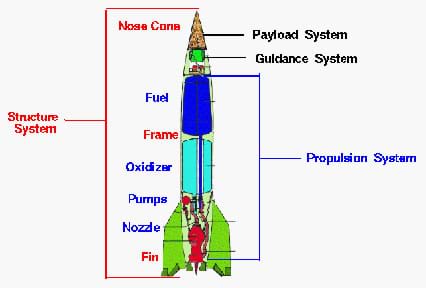
Other common rocket elements include fins, fuel tanks and nose cones. The fins are small wings that keep a rocket moving straight ahead. The great amount of energy required to leave the Earth's surface comes from fuel stored in huge fuel tanks. The nose cone on the tip of the rocket helps the rocket slice through the air. Without the nose cone, it would be much harder for the rocket to move though the atmosphere on the way to space.
Photo shows space shuttle positioned upright for launch, with external tank, solid rocket boosters and orbiter labeled.
Main components of the space shuttle.
On a typical spacecraft, we might also see heat shields, antennae, parachutes, computers, scientific instruments, solar panels and thrusters. The heat shield protects the spacecraft from the heat of re-entry, while parachutes are often employed to ensure a safe landing. Antennae are important for communicating with the ground and sending scientific data. Computers monitor the spacecraft and help the astronauts operate the craft and perform experiments. Thrusters are small rockets that maneuver the spacecraft while it is in space. Solar panels help provide the craft with power; they turn the Sun's rays into electrical power.
The US space shuttle is designed to transport people and cargo to and from orbit around Earth. The main space shuttle components are two solid rocket boosters (contains solid fuel used to push the shuttle into the air), an external tank (holds liquid fuel) and the orbiter (includes a crew cabin for up to seven people; a cargo bay for supplies and equipment, and three engines). A great amount of the space shuttle is devoted to providing fuel. After liftoff, when the solid rocket fuel is gone, the boosters fall back down to Earth. Next, when empty, the external tank comes off. Then, the orbiter reaches space; it is able to return to Earth and land like an airplane. Everything except the external fuel tank is used for another shuttle flight.
Engineers are responsible for all these rocket, spacecraft and shuttle elements. Without them, space travel would not be possible. It is when all these carefully-designed elements work together that we have a successful space mission.

Vocabulary/Definitions

A process in which one type of substance is chemically converted to another substance involving an exchange of energy.
A person who applies his/her understanding of science and math to creating things for the benefit of humanity and our world.
gas:
Tiny particles with enough energy to remain isolated and free floating (as opposed to liquids and solids in which particles group together).
For every action there is an equal and opposite reaction. (This is why rockets work!)
The exertion of force upon a surface by an object, fluid, gas (etc.), in contact with it. Force per area. Measured in units of pounds per square inch (psi) or newtons per square meter (N/m^2) or pascals (Pa). Pressure results from collisions of gas molecules with a surface
A vehicle that moves by ejecting fuel.
The forward-directed force on a rocket in reaction to the ejection of fuel.


From: https://www.teachengineering.org/view_lesson.php?url=collection/cub_/lessons/cub_solar/cub_solar_lesson01.xml

Tuesday, February 9, 2016

Study Guide for Science Test


Tomorrow we have a science test. Here is an AWESOME website that will help you review the concepts that are on the test.

Review website click: HERE

You can also get on the other rock websites and it will help you review.

In addition to websites here are a few concepts you will need to know for the test.

·         Vocabulary: streak, hardness, igneous rock, deposition, sedimentary rock, metamorphic rock, erosion, rock cycle

·         What is luster?

·         How does sedimentary rock become sedimentary? How do they become metamorphic? How do they become igneous?

·         What is found in soil?

·         What are minerals?

·         Classification of rocks (how to test hardness and streak)


·         What is weathering? What is erosion?

Happy studying you rock hounds. You will "ROCK" this test....hahahaha...man I crack myself up!

Thursday, February 4, 2016

Rosa Parks

Did you know today, February 4, 2016, is Rosa Parks' birthday?! How perfect as the 5th grade has been studying the impact of Rosa Parks and the leader she was. Ask your students about the impact that she has made, even on us today.

Here is a video I found to learn more about Rosa Parks. Let me know if you find any neat websites about her that you would like to share for your friends.

click here for video: VIDEO

Monday, February 1, 2016

Science Website

Hello fellow scientists!!

We are studying layers of the earth, rock cycle and earth processes. Check out this link below to investigate further about the things we are learning in class. Please see if you can find any other science websites and I would be more than happy to share them here.


Monday, January 11, 2016

DEAR reading form

Name ________________________________________________ Date _______


D.E.A.R. Reading Response
Title: _____________________________________________________________
Author: ___________________________________________________________
 Fiction  Nonfiction
D = Direct Quote
Word for word from the text
____________________________________________________________________
____________________________________________________________________
____________________________________________________________________
____________________________________________________________________
page ______

E = Explanation Write a summary of the quote.
____________________________________________________________________
____________________________________________________________________
____________________________________________________________________
____________________________________________________________________
A = Author’s Purpose
Why did the author include this?
____________________________________________________________________
____________________________________________________________________
____________________________________________________________________
____________________________________________________________________
R = Response
Make a connection, make a prediction, or imagine you are the
character.
____________________________________________________________________
____________________________________________________________________
____________________________________________________________________
____________________________________________________________________

BMK #1

Dear Parents,

          All fifth graders in the State of Kansas take a state math assessment in March or April.  This assessment is part of the measurement for the “No Child Left Behind” Act.  The fifth grade math assessment requires the students to be able to apply higher level math and problem solving skills.  In order to be able to solve these higher level math problems, the students must have some basic math knowledge memorized.  Classrooms must test in a “sterile” environment, meaning the students cannot use any references.  This means that in order for our students to be able to solve the higher level application problems, students will need to memorize this basic information.  All of the knowledge that we expect the students to memorize is information that we have taught and practiced repeatedly in class.
          Starting this week, your child will be receiving a “basic math knowledge” list on Mondays.  This list will become a cumulative list of knowledge.  If students learn the information in the first week, it will be easier to learn only 3 – 5 more new concepts each week.  Again, all of the knowledge items on the list are information that students have been taught and practiced repeatedly in class since fourth grade.
          On Fridays, we will test the students on this knowledge.  Those students who do not know the information will receive extra help after school and/or during CATS Club to help them master this information.
          If you have any questions, please let us know. We are hoping this will help all students to become stronger math students.  Thank you for your support!


Basic Math Knowledge – Week 1

1.  What is the answer to an addition problem called?                 Sum

2.  What is the answer to a subtraction problem called?            Difference

3.  What is the value of a digit?                                                How much it is worth

4.  What is a digit?                            A single number (like 0, 1, 2, 3, 4, 5, 6, 7, 8, 9)


5.  What is an expression?                  Numbers, variables, and or symbols that show a mathematical relationship